Running a veterinary clinic isn’t just about delivering quality medical care — it’s also about managing rising operating costs, payroll obligations, and unpredictable payment cycles. Many veterinarians enter the profession driven by care and compassion, only to find themselves navigating tight margins shaped by external financial pressures such as inflation, staffing shortages, and payment delays.
At PetCoverage.ai, we see how delayed payments, unpaid invoices, and affordability concerns can disrupt otherwise well-run practices. Our role is to help reduce financial friction by ensuring pet parents are prepared to say “yes” to care, supporting more consistent revenue flow for clinics while keeping the focus on patient outcomes.
This article breaks down where veterinary clinic revenue typically goes, highlights common financial pressure points, and explains how insurance readiness contributes to greater stability.
The Emotional Truth Behind Veterinary Revenue
Veterinary medicine is a calling — but clinics still operate within economic constraints. Industry reporting from the American Veterinary Medical Association (AVMA), alongside practice management and financial benchmarking guidance from the Veterinary Hospital Managers Association (VHMA), indicates that operating expenses have continued to rise while revenue growth has softened across many regions.
Understanding how revenue is allocated — and where it can leak — is increasingly important for long-term sustainability.
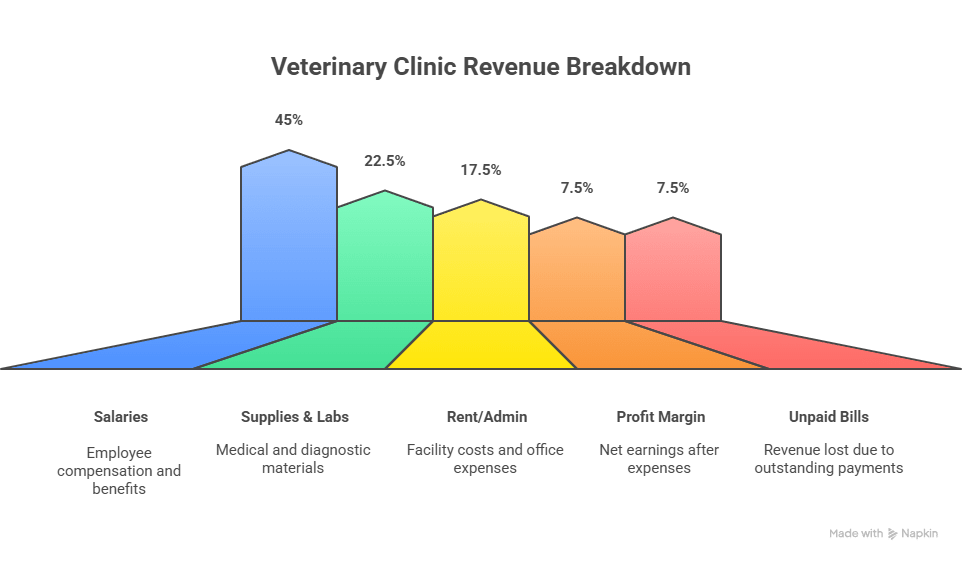
Typical Veterinary Clinic Revenue Breakdown (Industry Ranges)
These ranges reflect commonly reported benchmarks from the American Veterinary Medical Association (AVMA), the Veterinary Hospital Managers Association (VHMA), and Veterinary Economics.
Salaries: 40–50% of revenue
Medical supplies, labs, and equipment: 20–25%
Rent, utilities, and administration: 15–20%
Net profit margin: Often under 10%, according to AVMA, VHMA, and Veterinary Economics practice benchmarks
Salaries: The Heart of the Practice — and the Largest Expense
Staffing is both a clinic’s greatest strength and its highest cost.
Veterinarians: 20–25% of revenue
Veterinary technicians and nurses: 10–12%
Administrative staff: 5–8%
These figures are drawn from VHMA and Veterinary Economics staffing and compensation benchmarks. Payroll pressure can increase further due to overtime, recruitment, and training costs.
Staff turnover — often linked to workload intensity and market-wide labor shortages — adds indirect costs that affect both financial performance and continuity of care.
Medical Supplies, Labs, and Equipment
Medical inputs typically account for 20–25% of clinic revenue, according to AVMA and Veterinary Economics benchmarking data.
Common cost drivers include:
Overstocked or expired inventory
Emergency sourcing at premium pricing
Variable external laboratory fees
When recommended treatments are delayed or declined due to cost uncertainty, clinics may absorb inefficiencies tied to unused inventory and lost production time.
Insurance-ready clients are more likely to proceed with care, helping clinics use supplies as intended rather than absorbing waste.
Rent, Utilities, and Administrative Expenses
Fixed overhead — including rent, utilities, software systems, and administrative operations — generally consumes 15–20% of clinic revenue, regardless of patient volume, according to VHMA benchmarks.
This creates exposure during slower periods, when income fluctuates but expenses remain constant.
More predictable payment flows help reduce pressure on fixed costs and support steadier cash-flow planning.
The Hidden Cost of Unpaid Bills
Unpaid and delayed invoices remain one of the most persistent financial stressors in veterinary medicine.
Industry analysis from Veterinary Economics and the Veterinary Hospital Managers Association (VHMA) suggests that 5–10% of annual clinic revenue may be lost to delayed or uncollected payments.
For a clinic generating $1 million annually, that represents $50,000–$100,000 in earned but unrealized income.
At PetCoverage.ai, we observe that clinics working with insured pet owners experience fewer payment disruptions, reducing administrative burden and smoothing revenue cycles without changing care standards.
Insurance and Treatment Approval Rates
According to a 2024 study published by the North American Pet Health Insurance Association (NAPHIA), insured pet owners were up to three times more likely to approve advanced or comprehensive treatment plans compared to uninsured clients.
This is associated with:
Fewer unpaid balances
Higher treatment adherence
More predictable revenue realization
At PetCoverage.ai, we consistently see that financial preparedness removes hesitation at the point of care, benefiting pets, clients, and clinic teams alike.
How Clinics Strengthen Revenue Stability in 2025
Improving financial performance does not require higher fees — it often comes from improving systems and preparedness.
Effective strategies include:
Insurance education: Clients with coverage are less likely to delay care
Preventive care programs: Support predictable revenue streams
Clear financial communication: Improves client confidence and compliance
Quarterly financial reviews: Identify margin pressure early
Retention focus: Long-term client relationships stabilize revenue
These approaches apply whether learning how to run a veterinary clinic efficiently or refining veterinary revenue cycle management.

Frequently Asked Questions (FAQs)
1. How much profit should a veterinary clinic aim for?
Industry benchmarks from AVMA and VHMA suggest 10–15%, though many clinics operate below this range due to rising costs and payment delays.
2. What’s the biggest hidden threat to clinic revenue?
Delayed and unpaid invoices remain one of the most significant drains on profitability.
3. How does pet insurance affect clinic revenue?
Industry data shows higher treatment acceptance and fewer unpaid balances among insured clients
4. How often should a clinic review its revenue breakdown?
Quarterly reviews are considered best practice.
5. Can small clinics really compete financially in 2025?
Yes — particularly by reducing payment friction and focusing on client preparedness.
Key Takeaways
In reviewing the veterinary clinic revenue breakdown, several realities stand out: costs are rising, margins remain tight, and unpaid bills continue to strain cash flow. These challenges are structural — not a reflection of care quality or competence — and they can be addressed with preparation.
Protect cash flow: Insurance readiness helps reduce revenue lost to unpaid invoices
Maximize efficiency: Align staffing, supplies, and overhead to prevent small leaks from growing
Grow with prepared clients: Covered pet parents approve care more consistently, supporting both outcomes and revenue
We’ve explored how clinics can understand where money goes, how veterinary revenue statistics reveal hidden pressure points, and how insurance supports financial stability alongside quality care.
For more insights and the latest veterinary business news, follow PetCoverage.ai on Facebook, Instagram, TikTok, and LinkedIn.
👉 Want to strengthen your clinic’s financial stability? Guide your clients to PetCoverage.ai today.