Every veterinary practice begins with passion—helping animals live healthier lives. But passion alone doesn’t pay the bills. Rising veterinary costs, staffing shortages, and supply chain pressure are placing sustained financial strain on clinics across the country. Many veterinarians now find themselves balancing patient care with the realities of operating costs, reimbursement delays, and uneven cash flow.
At PetCoverage.ai, we believe no clinic should have to choose between patient care and financial stability. By helping pet parents prepare for treatment costs through insurance, we help reduce unpaid balances and billing friction—allowing clinics to focus more fully on care delivery rather than collections.
If you’ve been wondering how to cut costs at a veterinary practice without losing care quality, this guide outlines the key cost drivers in 2025 and the most effective ways clinics are responding.
The Emotional Side of Rising Veterinary Costs
Veterinary medicine is more than a business—it’s a calling. But rising costs can quietly erode even the most mission-driven practice.
According to October 2024 industry data from American Veterinary Medical Association, patient visits declined 2.3% year over year, while total practice revenue increased 3.9%, largely due to higher service and operating costs.
This growing gap—lower visit volume paired with higher expenses—has intensified financial pressure across the profession. Industry benchmarking indicates that veterinary costs have continued to rise faster than general inflation, driven by labor shortages, medical supply pricing, and regional overhead differences.
Common veterinary practice cost benchmarks in 2025:
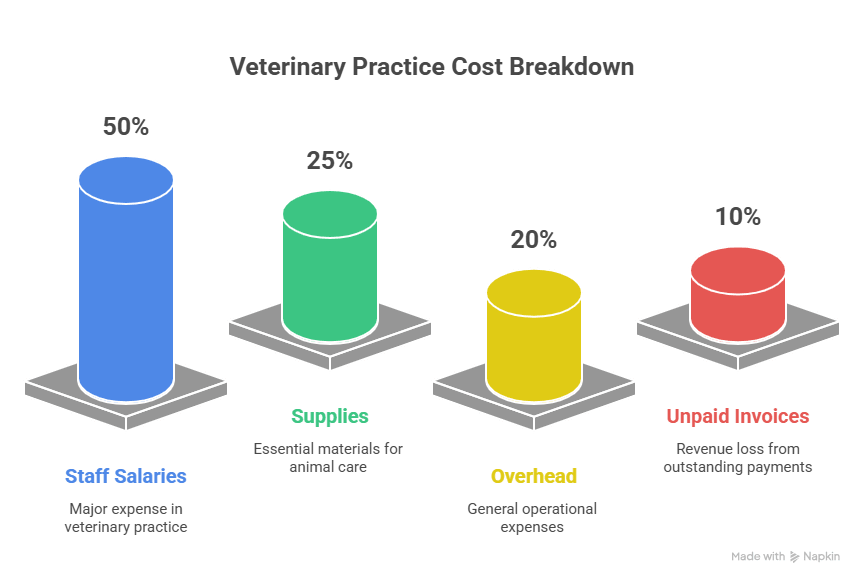
Staff salaries and benefits: 45–55% of revenue
Supplies and laboratory services: 20–25%
Rent, utilities, and overhead: 15–20%
Profit margins: Often under 10%
These benchmarks suggest that cutting care is not a viable solution. Instead, clinics must focus on efficiency, waste reduction, and revenue predictability.
Staff Costs: Your Greatest Asset and Greatest Expense
Veterinary teams are the foundation of patient care—and the largest line item on a clinic’s balance sheet. Workforce benchmarking from veterinary industry sources shows that payroll commonly accounts for nearly half of total revenue.
Labor shortages, rising wages, and burnout have increased the financial impact of overtime and turnover. State and national workforce reports indicate that replacing trained veterinary staff is significantly more expensive than retaining them, particularly in competitive labor markets.
Smarter ways to manage staff costs without sacrificing care:
Schedule teams based on actual client demand patterns
Cross-train staff to improve coverage flexibility
Invest in retention programs that reduce costly turnover
Important: Cost-cutting through overwork leads to burnout, errors, and rehiring cycles. Industry workforce reports consistently show that staff fatigue undermines patient care and long-term profitability.
Where insurance helps: When clients are financially prepared, staff spend less time navigating payment conversations and more time delivering care.
Supplies, Labs, and Equipment: The Silent Drain
Medical supplies, diagnostics, and laboratory services typically account for 20–25% of clinic revenue, according to financial benchmarks published by veterinary industry analysts and trade publications.
A common source of avoidable loss is inventory inefficiency—expired products, emergency restocking at premium prices, and underutilized equipment.
Cost-control strategies supported by industry best practice:
Track inventory to minimize expiration waste
Negotiate supplier contracts based on usage volume
Regularly evaluate in-house versus outsourced lab economics
State-level cost analyses from veterinary industry sources show that regional cost variation is significant. Practices in high-cost states—such as California—often face 20–30% higher operating costs than clinics in lower-cost regions due to rent, wages, and regulatory requirements.
Understanding local cost structure allows practices to plan realistically rather than compare themselves unfairly to lower-cost markets.
Rent, Utilities, and Overhead
Fixed overhead expenses—including rent, utilities, insurance, and administrative services—typically represent 15–20% of practice revenue based on industry benchmarking.
These costs remain constant even when appointment volume fluctuates, making them particularly challenging during seasonal slowdowns.
Ways clinics manage overhead without reducing care access:
Renegotiate service and lease contracts annually
Implement energy-efficiency measures
Use telehealth selectively to extend care without expanding physical space
Clinics with predictable cash flow are better positioned to absorb overhead volatility during slower months.
The Hidden Leak: Unpaid Bills
One of the most persistent financial drains in veterinary practice operations is unpaid or delayed invoices.
Industry benchmarking and revenue cycle analyses indicate that clinics may lose 5–10% of annual revenue due to delayed or uncollected payments. For a practice generating $1 million annually, that represents $50,000–$100,000 in revenue already earned but never realized.
Steps clinics use to reduce this loss:
Automate billing and reminder systems
Offer structured payment options
Encourage insurance adoption to reduce payment uncertainty
Brand reinforcement: At PetCoverage.ai, we’ve observed that when insurance is in place, billing disputes decrease and collections become more predictable—reducing administrative strain for both staff and clients.
Case Study: A Texas Clinic’s Turnaround
A mid-sized veterinary practice in Texas faced mounting financial pressure despite a full appointment calendar.
Operational review identified:
8% of invoices unpaid beyond 60 days
Approximately $20,000 in annual supply expiration waste
Excess staff overtime linked to scheduling inefficiencies
After improving revenue cycle processes and encouraging insurance awareness among clients, the clinic experienced:
18% improvement in collections
20% reduction in supply waste
Lower overtime and improved staff satisfaction
This example reflects how operational efficiency—not reduced care—can stabilize clinic finances.
How to Cut Costs at a Veterinary Practice Without Sacrificing Care
Veterinary practices seeking sustainable cost control consistently focus on five areas:
Automate repetitive tasks – Scheduling, reminders, and invoicing reduce labor strain
Educate clients – Informed pet parents are more likely to proceed with care
Offer preventive care bundles – Predictable care supports predictable revenue
Review financials quarterly – Early detection prevents compounding losses
Encourage insurance enrollment – Financially prepared clients support treatment acceptance and revenue stability
These approaches prioritize efficiency and preparedness—not care reduction.

Frequently Asked Questions (FAQs)
1. What is the biggest hidden cost for veterinary practices?
Unpaid or delayed invoices, which quietly weaken cash flow.
2. Can cutting staff costs hurt patient care?
Yes. Industry workforce reports link burnout to higher error rates and turnover.
3. How does pet insurance help clinics manage costs?
It reduces billing disputes and improves payment predictability.
4. Do veterinary costs vary by state?
Yes. State-level analyses show operating costs can be 20–30% higher in high-cost regions.
5. What’s the fastest way to improve profitability?
Address unpaid invoices and strengthen revenue predictability.
Key Takeaways
In reviewing how to cut costs at a veterinary practice, one truth stands out: clinics can reduce expenses without cutting care quality.
Protect Revenue: Reduce unpaid invoices and strengthen cash flow with insurance-ready clients.
Manage Smarter: Focus on staff retention, inventory tracking, and overhead control.
Grow Sustainably: Prevention-focused care and loyal clients boost long-term revenue.
We’ve explored where money goes, where it gets lost, and how to protect your bottom line without sacrificing pets’ well-being.
For practical insights, revenue solutions, and the latest veterinary business news, follow PetCoverage.ai on Facebook, Instagram, TikTok, and LinkedIn.
Ready to secure your clinic’s financial future? Guide your clients to PetCoverage.ai today.